$$
\newcommand{\defeq}{\stackrel{\small\bullet}{=}}
\newcommand{\ra}{\rangle}
\newcommand{\la}{\langle}
\newcommand{\norm}[1]{\left\|#1\right\|}
\newcommand{\abs}[1]{\left\lvert#1\right\rvert}
\newcommand{\Abs}[1]{\Bigl\lvert#1\Bigr\rvert}
\newcommand{\pr}{{\mathbb P}}
\newcommand{\qr}{{\mathbb Q}}
\newcommand{\xv}{{\boldsymbol{x}}}
\newcommand{\av}{{\boldsymbol{a}}}
\newcommand{\bv}{{\boldsymbol{b}}}
\newcommand{\cv}{{\boldsymbol{c}}}
\newcommand{\dv}{{\boldsymbol{d}}}
\newcommand{\ev}{{\boldsymbol{e}}}
\newcommand{\fv}{{\boldsymbol{f}}}
\newcommand{\gv}{{\boldsymbol{g}}}
\newcommand{\hv}{{\boldsymbol{h}}}
\newcommand{\nv}{{\boldsymbol{n}}}
\newcommand{\sv}{{\boldsymbol{s}}}
\newcommand{\tv}{{\boldsymbol{t}}}
\newcommand{\uv}{{\boldsymbol{u}}}
\newcommand{\vv}{{\boldsymbol{v}}}
\newcommand{\wv}{{\boldsymbol{w}}}
\newcommand{\zerov}{{\mathbf{0}}}
\newcommand{\onev}{{\mathbf{0}}}
\newcommand{\phiv}{{\boldsymbol{\phi}}}
\newcommand{\cc}{{\check{C}}}
\newcommand{\xv}{{\boldsymbol{x}}}
\newcommand{\Xv}{{\boldsymbol{X}\!}}
\newcommand{\yv}{{\boldsymbol{y}}}
\newcommand{\Yv}{{\boldsymbol{Y}}}
\newcommand{\zv}{{\boldsymbol{z}}}
\newcommand{\Zv}{{\boldsymbol{Z}}}
\newcommand{\Iv}{{\boldsymbol{I}}}
\newcommand{\Jv}{{\boldsymbol{J}}}
\newcommand{\Cv}{{\boldsymbol{C}}}
\newcommand{\Ev}{{\boldsymbol{E}}}
\newcommand{\Fv}{{\boldsymbol{F}}}
\newcommand{\Gv}{{\boldsymbol{G}}}
\newcommand{\Hv}{{\boldsymbol{H}}}
\newcommand{\alphav}{{\boldsymbol{\alpha}}}
\newcommand{\epsilonv}{{\boldsymbol{\epsilon}}}
\newcommand{\betav}{{\boldsymbol{\beta}}}
\newcommand{\deltav}{{\boldsymbol{\delta}}}
\newcommand{\gammav}{{\boldsymbol{\gamma}}}
\newcommand{\etav}{{\boldsymbol{\eta}}}
\newcommand{\piv}{{\boldsymbol{\pi}}}
\newcommand{\thetav}{{\boldsymbol{\theta}}}
\newcommand{\tauv}{{\boldsymbol{\tau}}}
\newcommand{\muv}{{\boldsymbol{\mu}}}
\newcommand{\phiinv}{\Phi^{-1}}
\newcommand{\Fiinv}{F^{-1}}
\newcommand{\giinv}{g^{-1}}
\newcommand{\fhat}{\hat{f}}
\newcommand{\ghat}{\hat{g}}
\newcommand{\ftheta}{f_\theta}
\newcommand{\fthetav}{f_{\thetav}}
\newcommand{\gtheta}{g_\theta}
\newcommand{\gthetav}{g_{\thetav}}
\newcommand{\ztheta}{Z_\theta}
\newcommand{\xtheta}{\Xv_\theta}
\newcommand{\ytheta}{\Yv_\theta}
\newcommand{\p}{\partial}
\newcommand{\f}{\frac}
\newcommand{\cf}{\cfrac}
\newcommand{\e}{\epsilon}
\newcommand{\indep}{\perp\kern-5pt \perp}
\newcommand{\inner}[1]{\langle#1\rangle}
\newcommand{\pa}[1]{\left(#1\right)}
\newcommand{\pb}[1]{\left\{#1\right\}}
\newcommand{\pc}[1]{\left[#1\right]}
\newcommand{\pA}[1]{\Big(#1\Big)}
\newcommand{\pB}[1]{\Big\{#1\Big\}}
\newcommand{\pC}[1]{\Big[#1\Big]}
\newcommand{\ty}[1]{\texttt{#1}}
\newcommand{\borel}[1]{\mathscr{B}\pa{#1}}
\newcommand{\scr}{\mathcal}
\newcommand{\scrb}{\mathscr}
\newcommand{\argmin}{\mathop{\text{arg}\ \!\text{min}}}
\newcommand{\arginf}{\mathop{\text{arg}\ \!\text{inf}}}
\newcommand{\argmax}{\mathop{\text{arg}\ \!\text{max}}}
\newcommand{\argsup}{\mathop{\text{arg}\ \!\text{sup}}}
\newcommand{\bigo}[1]{\mathcal{O}_{p}\!\left(#1\right)}
\newcommand{\f}{\frac}
\newcommand{\e}{\epsilon}
\newcommand{\inv}{^{-1}}
\newcommand{\phiinv}{\Phi^{-1}}
\newcommand{\Fiinv}{F^{-1}}
\newcommand{\giinv}{g^{-1}}
\newcommand{\fhat}{\hat{f}}
\newcommand{\ghat}{\hat{g}}
\newcommand{\ftheta}{f_\theta}
\newcommand{\fthetav}{f_{\thetav}}
\newcommand{\gtheta}{g_\theta}
\newcommand{\gthetav}{g_{\thetav}}
\newcommand{\ztheta}{Z_\theta}
\newcommand{\xtheta}{\Xv_\theta}
\newcommand{\ytheta}{\Yv_\theta}
\newcommand{\absdet}[1]{\abs{\det\pa{#1}}}
\newcommand{\jac}[1]{\Jv_{#1}}
\newcommand{\absdetjx}[1]{\abs{\det\pa{\Jv_{#1}}}}
\newcommand{\absdetj}[1]{\norm{\Jv_{#1}}}
\newcommand{\sint}{sin(\theta)}
\newcommand{\cost}{cos(\theta)}
\newcommand{\sor}[1]{S\mathcal{O}(#1)}
\newcommand{\ort}[1]{\mathcal{O}(#1)}
\newcommand{\A}{{\mathcal A}}
\newcommand{\C}{{\mathbb C}}
\newcommand{\E}{{\mathbb E}}
\newcommand{\F}{{\mathcal{F}}}
\newcommand{\N}{{\mathbb N}}
\newcommand{\R}{{\mathbb R}}
\newcommand{\Q}{{\mathbb Q}}
\newcommand{\Z}{{\mathbb Z}}
\newcommand{\X}{{\mathbb{X}}}
\newcommand{\Y}{{\mathbb{Y}}}
\newcommand{\G}{{\mathcal{G}}}
\newcommand{\M}{{\mathcal{M}}}
\newcommand{\betaequivalent}{\beta\text{-equivalent}}
\newcommand{\betaequivalence}{\beta\text{-equivalence}}
\newcommand{\Mb}{{\boldsymbol{\mathsf{M}}}}
\newcommand{\Br}{{\mathbf{\mathsf{Bar}}}}
\newcommand{\dgm}{{\mathfrak{Dgm}}}
\newcommand{\Db}{{\mathbf{\mathsf{D}}}}
\newcommand{\Img}{{\mathbf{\mathsf{Img}}}}
\newcommand{\mmd}{{\mathbf{\mathsf{MMD}}}}
\newcommand{\Xn}{{\mathbb{X}_n}}
\newcommand{\Xm}{{\mathbb{X}_m}}
\newcommand{\Yn}{{\mathbb{Y}_n}}
\newcommand{\Ym}{Y_1, Y_2, \cdots, Y_m}
\newcommand{\Xb}{{\mathbb{X}}}
\newcommand{\Yb}{{\mathbb{Y}}}
\newcommand{\s}{{{\sigma}}}
\newcommand{\fnsbar}{{\bar{f}^n_\s}}
\newcommand{\fns}{{f^n_\s}}
\newcommand{\fs}{{f_\s}}
\newcommand{\fsbar}{{\bar{f}_\s}}
\newcommand{\barfn}{{{f}^n_\sigma}}
\newcommand{\barfnm}{{{f}^{n+m}_\sigma}}
\newcommand{\barfo}{{{f}_\sigma}}
\newcommand{\fn}{{f^n_{\rho,\sigma}}}
\newcommand{\fnm}{{f^{n+m}_{\rho,\sigma}}}
\newcommand{\fo}{{f_{\rho,\sigma}}}
\newcommand{\K}{{{K_{\sigma}}}}
\newcommand{\barpn}{{\bar{p}^n_\sigma}}
\newcommand{\barpo}{{\bar{p}_\sigma}}
\newcommand{\pn}{{p^n_\sigma}}
\newcommand{\po}{{p_\sigma}}
\newcommand{\J}{{\mathcal{J}}}
\newcommand{\B}{{\mathcal{B}}}
\newcommand{\pt}{{\tilde{\mathbb{P}}}}
\newcommand{\Winf}{{W_{\infty}}}
\newcommand{\winf}{{W_{\infty}}}
\newcommand{\HH}{{{\scr{H}_{\sigma}}}}
\newcommand{\D}{{{\scr{D}_{\sigma}}}}
\newcommand{\Ts}{{T_{\sigma}}}
\newcommand{\Phis}{{\Phi_{\sigma}}}
\newcommand{\nus}{{\nu_{\sigma}}}
\newcommand{\Qs}{{\mathcal{Q}_{\sigma}}}
\newcommand{\ws}{{w_{\sigma}}}
\newcommand{\vs}{{v_{\sigma}}}
\newcommand{\ds}{{\delta_{\sigma}}}
\newcommand{\fp}{{f_{\pr}}}
\newcommand{\prs}{{\widetilde{\pr}_{\sigma}}}
\newcommand{\qrs}{{\widetilde{\qr}_{\sigma}}}
\newcommand{\Inner}[1]{\Bigl\langle#1\Bigr\rangle}
\newcommand{\innerh}[1]{\langle#1\rangle_{\HH}}
\newcommand{\Innerh}[1]{\Bigl\langle#1\Bigr\rangle_{\HH}}
\newcommand{\normh}[1]{\norm{#1}_{\HH}}
\newcommand{\norminf}[1]{\norm{#1}_{\infty}}
\newcommand{\gdelta}{{\G_{\delta}}}
\newcommand{\supgdelta}{{\sup\limits_{g\in\gdelta}\abs{\Delta_n(g)}}}
\newcommand{\id}{\text{id}}
\newcommand{\supp}{\text{supp}}
\newcommand{\cech}{\v{C}ech}
\newcommand{\Zz}{{\scr{Z}}}
\newcommand{\psis}{\psi_\s}
\newcommand{\phigox}{\Phis(\xv)-g}
\newcommand{\phigoy}{\Phis(\yv)-g}
\newcommand{\fox}{{f^{\epsilon,{\xv}}_{\rho,\sigma}}}
\newcommand{\prx}{{\pr^{\epsilon}_{\xv}}}
\newcommand{\pro}{{\pr_0}}
\newcommand{\dotfo}{\dot{f}_{\!\!\rho,\s}}
\newcommand{\phifo}{{\Phis(\yv)-\fo}}
\newcommand{\phifox}{{\Phis(\xv)-\fo}}
\newcommand{\kinf}{{\norm{\K}_{\infty}}}
\newcommand{\half}{{{\f{1}{2}}}}
\newcommand{\Jx}{\J_{\epsilon,{\xv}}}
\newcommand{\dpy}{\text{differential privacy}}
\newcommand{\edpy}{$\epsilon$--\text{differential privacy}}
\newcommand{\eedpy}{$\epsilon$--edge \text{differential privacy}}
\newcommand{\dpe}{\text{differentially private}}
\newcommand{\edpe}{$\epsilon$--\text{differentially private}}
\newcommand{\eedpe}{$\epsilon$--edge \text{differentially private}}
\newcommand{\er}{Erdős-Rényi}
\newcommand{\krein}{Kreĭn}
% \newcommand{\grdpg}{\mathsf{gRDPG}}
% \newcommand{\rdpg}{\mathsf{RDPG}}
% \newcommand{\eflip}{{\textsf{edgeFlip}}}
% \newcommand{\grdpg}{\text{gRDPG}}
% \newcommand{\rdpg}{\text{RDPG}}
\newcommand{\grdpg}{\mathsf{gRDPG}}
\newcommand{\rdpg}{\mathsf{RDPG}}
\newcommand{\eflip}{{\text{edgeFlip}}}
\newcommand{\I}{{\mathbb I}}
\renewcommand{\pa}[1]{\left(#1\right)}
\renewcommand{\pb}[1]{\left\{#1\right\}}
\renewcommand{\pc}[1]{\left[#1\right]}
\renewcommand{\V}{\mathbb{V}}
\renewcommand{\W}{\mathbb{W}}
%%%%%%%%%%%%%%%%%%%%%%%%%%%
\providecommand{\fd}{\frac 1d}
% \renewcommand{\fpp}{{\frac 1p}}
\providecommand{\pfac}{\f{p}{p-1}}
\providecommand{\ipfac}{\f{p-1}{p}}
\providecommand{\dbq}{\Delta b_{n,m,Q}\qty(\qty{\xvo})}
\providecommand{\db}{\Delta b_{n,m}\qty(\qty{\xvo})}
\providecommand{\bbv}{{{\mathbb{V}}}}
\providecommand{\bbw}{{{\mathbb{W}}}}
\providecommand{\md}{\textsf{MoM Dist}}
\providecommand{\bF}{{\mathbf{F}}}
\providecommand{\sub}{{\text{Sub}}}
\providecommand{\samp}{\text{$\pa{\scr{S}}$}}
\providecommand{\tp}{{2^{\f{p-1}{p}}}}
%%%%%%%%%%%%%%%%%%%%%%%%%%
\providecommand{\Xmn}{{\mathbb{X}_{n+m}}}
\newcommand{\Dnmq}{\D[n+m, Q]}
\newcommand{\Dnmh}{\D[n+m, \H]}
\newcommand{\Dn}{\D[n]}
\providecommand{\xvo}{\xv_0}
\providecommand{\bn}[1][\null]{b^{#1}_{n}\pa{\pb{\xvo}}}
\providecommand{\bnm}[1][\null]{b^{#1}_{n+m}\pa{\pb{\xvo}}}
\providecommand{\bnq}[1][\null]{b^{#1}_{n,Q}\pa{\pb{\xvo}}}
\providecommand{\bnmq}[1][\null]{b^{#1}_{n+m,Q}\pa{\pb{\xvo}}}\providecommand{\prq}{\pr_q}
\providecommand{\dxvo}{{\delta_{\xvo}}}
\providecommand{\sq}{S_q}
\providecommand{\Sq}{\abs{S_q}}
\providecommand{\no}{{n_o}}
\providecommand{\mmdn}{\mmd\pa{\pr_n, \delta_{\xvo}}}
\newcommand{\rqt}{\xi_{q}(t; n, Q)}
\providecommand{\nq}{\f{n}{Q}}
\providecommand{\Ot}{\Omega(t, n/Q)}
\providecommand{\ut}[1]{U^{#1}}
\providecommand{\vt}[1]{V^{#1}}
\providecommand{\wt}[1]{W^{#1}}
\providecommand{\but}[1]{\mathbb{U}^{#1}}
\providecommand{\bvt}[1]{\mathbb{V}^{#1}}
\providecommand{\bwt}[1]{\mathbb{W}^{#1}}
\providecommand{\ball}[1]{B_{f\!, \rho}\pa{#1}}
\newcommand*{\medcap}{\mathbin{\scalebox{0.75}{{\bigcap}}}}%
\newcommand*{\medcup}{\mathbin{\scalebox{0.75}{{\bigcup}}}}%
\providecommand{\dsf}{\mathsf{d}}
\newcommand{\Dnh}{{\mathsf{D}_{n,\scr{H}}}}
\newcommand{\Dph}{{\mathsf{D}_{\pr,\scr{H}}}}
\newcommand{\D}[1][1={ },usedefault]{{\mathsf{D}_{#1}}}
\newcommand{\Dnq}{{\mathsf{D}_{n, Q}}}
\newcommand{\dnq}{{\mathsf{d}_{n, Q}}}
\newcommand{\dn}{{\mathsf{d}_{n}}}
\newcommand{\dnm}{{\mathsf{d}_{n-m}}}
\newcommand{\dmn}{{\mathsf{d}_{n+m}}}
\newcommand{\dx}{{\mathsf{d}_{\mathbb{X}}}}
\providecommand{\med}{\text{median}}
\providecommand{\median}{\text{median}}
\providecommand{\Xnm}{{\mathbb{X}^*_{n-m}}}
$$
Introduction (Week-1)
Math 183 • Statistical Methods • Spring 2026
Course Information
![]()
ucsd-math183.github.io/sp26
- Lectures. Tue/Thu. 3:30–4:50 PM
- Discussions. Thursday Evenings
- Midterm. Thu, Apr 30th, 2026
- Final. Mon, Jun 8th, 2026
Tips on succeeding in this course
Study Habits and Strategies
- Regular Review vs Cramming:
- Benefits of spaced repetition and active recall
- Long-term retention and understanding
- Active Participation:
- Engaging in class discussions
- Collaborative learning and group studies
- Look at the course policy here
Seeking Help and Utilizing Office Hours
- Recognizing the Need for Help:
- It’s okay to ask questions!
- Encouraging a culture of curiosity and inquiry
- Office Hours and TA Sessions:
- Make the most out of one-on-one interactions
- Collaborating and brainstorming with peers
- Accommodations:
- Commitment to creating an inclusive learning environment
- Students with documented disabilities can request necessary accommodations
- Processes in place for confidential discussions and implementations
Academic Integrity
- I’d much rather you ask for help from me or the TAs or discuss with your peers
- Please acknowledge your sources (if you use any)
FAQs
- How many homeworks will there be?
- Expect about 7-8 homeworks
- Will the lectures be podcast-ed?
- Yes, starting from Week-1 they will be uploaded automatically
- Are we allowed cheatsheets on the exam
- Yes. 1 A4/Letter sheet. Both sides are okay. It doesn’t have to be handwritten
- Will there be make-up exams
- No. There will be no make-up exams. However, there are two grading schemes in the event you don’t take your midterm
- Can I submit my assignment late?
- No.
- Seriously?
- Yes. But your lowest score will be dropped! 🙂
- I sent you an email and didn’t get a response!
- Please include “[Math 183]” in your subject and CC your TAs
Why Statistics?
- It’s a discipline centered around data.
- Collect: Gathering accurate and representative data for study.
- Describe: Summarizing data to grasp its main characteristics.
- Visualize: Representing data graphically for better understanding.
- Analyze: Extracting meaningful insights from data to make informed decisions.
- Empowered Decision Making:
- Proactive Choices: Leveraging data to make forward-thinking decisions.
- Critical Evaluation: Evaluating and scrutinizing decisions others make based on the data.
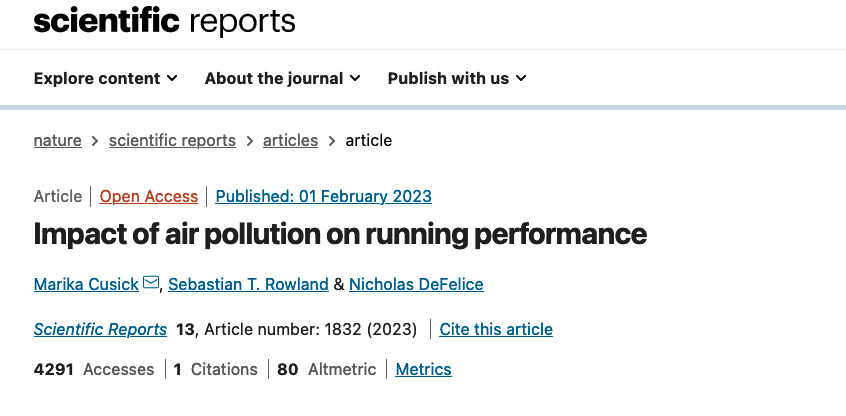
Examples
![]()
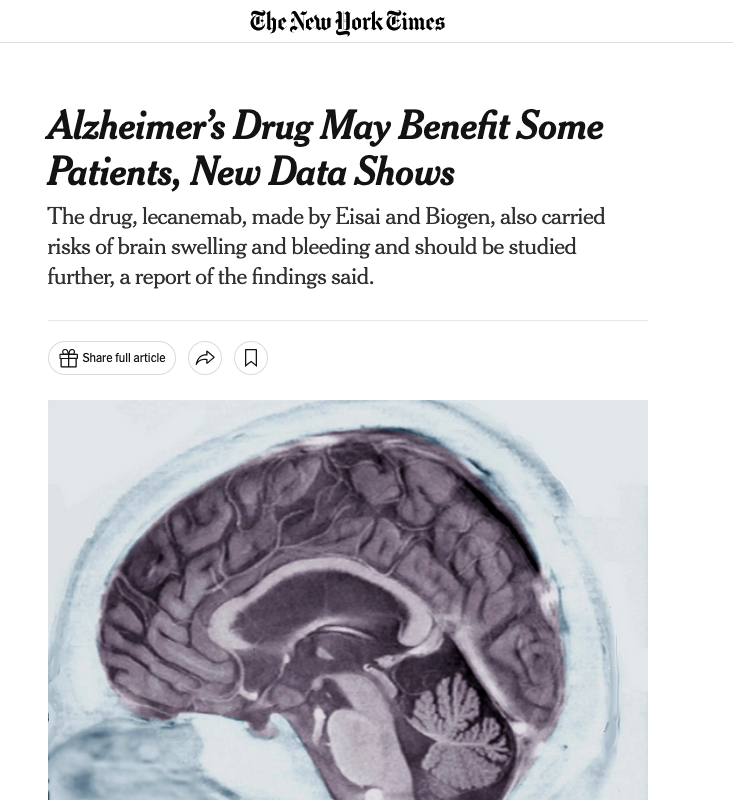
Examples
![]()
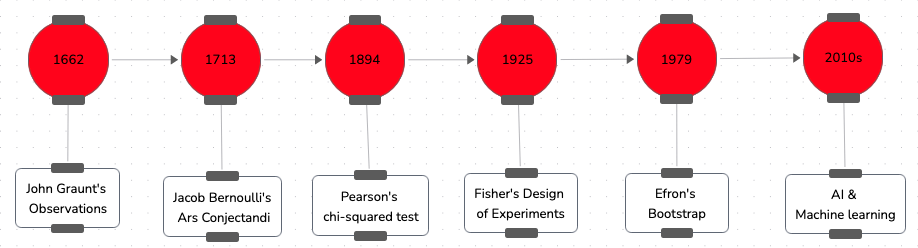
A Brief History of Statistics
![]()